Friday, October 24, 2008

Linni Eats L.A.: Pink's

Honeys, I’m home! And ready to continue my quest to devour the city of angels. With only one year left, that’s quite a formidable feat, but fret not, my lovelies—my stomach and I are ready.

There have been some changes since you last heard from me. Namely, I went vegan. What? How does a self-proclaimed cow-loving carnivorous culinary voyager swear off nearly half the world’s ingredients? Suppress your shock and awe, folks. Before you drop your newspaper and give up on me forever, let me just say—I’ll be eating all things animal for the sake of this column (or at least that’ll be my excuse if PETA ever comes knowing at my door). 

I know that’s kind of like calling myself a virgin while having sex for research, but that’s why I won’t be calling myself vegan anymore. In the privacy of my kitchen and groceries, it’ll be tempeh and tofu all the live-long day. But on the streets of L.A., plain guac tacos don’t cut it and foregoing carne asada is blasphemy. So without further adieu, I give you…

Pink’s. If you needed any proof that I won’t be treading lightly on this animal-laden path, here’s a place where you can get meat served on top of your meat, with some more meat on the side. Pink’s has served hot dogs to the stars on La Brea Blvd. since 1939, when it began as a taco truck-esque cart. It has since evolved into a modest storefront with ample seating, a spattering of signed celebrity photos and one hell of a kitchen viewing gallery to drool over while you wait in line.
This line was over an hour long when I visited on Labor Day. Call it masochistic, call it crazy—just make sure you bring some entertainment. I came armed with a crossword puzzle while the ladies behind me brought Pinkberry, proving that you can have dessert before dinner. After the first half hour, you start catching smells from the open kitchen, then you round the corner and it hits like an epiphany—THIS is why I’m waiting in this line.

An assembly line comes into view, where practiced sausage stylists adorn dogs with every topping imaginable. Sour cream? Ok! Melt-in-your-mouth pastrami? Sure thing. Strikingly adept at their craft, these ladies ladle chili and sling onion rings as if no one was watching. Mind you, they could count on at least twenty salivating faces staring back at them, should they choose to look up.
The menu has 14 regular hot dogs, five special dogs and 12 super special dogs. Most hover around four dollars, though many are cheaper. Only one exceeds six bucks, the Three Dog Night, but you get your money’s worth with three hot dogs wrapped in a giant tortilla, three slices each of cheese and bacon, chili and onions. Other super specials include the Mulholland Drive dog, the Martha Stewart dog and the Lord of the Rings dog—a ten-incher encircled by onion rings, nested in a bun and topped with BBQ sauce.
Pink’s is known for their ten-inch dogs that snap when you bite into them. Unfortunately, their Patt Morrison vegan Baja Veggie dog does not snap. I tested it out, thinking Mr. and Mrs. Pink wouldn’t put it on the menu if it wasn’t delicious. I did lick the guacamole off the limp, lifeless imposter, but I couldn’t bring myself to eat the thing itself. The bacon chili cheese dog, on the other hand, did not disappoint, and the ridiculously cheap sides helped, too. This is the only place I’ve encountered willing to slop chili onto tortilla chips and for that, they have my respect.

While I unfortunately have a threshold for grease, I’m already planning my next visit to Pink’s. I’ll need to try a plain hot dog to experience the famous snap. I’m also looking forward to cozying up with the Mushroom Swiss dog. I also can’t wait to try that pastrami, though that’s not exactly true—I can wait, and I will wait, however long the line is that day.


For a full menu, visit www.pinkshollywood.com

Tuesday, June 10, 2008

Linni Eats Cape Town: Africa Cafe

People are constantly asking why I came to Africa to study abroad, instead of the usuals, like Europe or Asia. My answer, aside from a chronic predilection to counterculture, mostly has to do with food.

Italian food, Mexican food, Spanish food, Chinese food, Indian food—there are myriad cultures I could name before we ran out of stock visual imagery or taste memories. But what appears in your mind when I bring up African food? Most people, myself included prior to this trip, would draw a blank. I can't speak for everyone, but I didn't like leaving an entire continent unaccounted for in my quest to eat the world. So I began this journey, not really sure what to expect outside the general categories of meat and starch. How did tribal southern Africans make use of their resources to satisfy cravings? What kind of evolutions had colonialism forced upon these methods?

In the U.S., it's standard to have low-end, no-name versions of a particular cuisine in addition to the nicer establishments. You can count on finding a non-descript Mexican joint on shady street corners, and there's certainly no shortage of cheap hot dog hole-in-the-walls. So I expected Africa to have some of these, serving up whatever the locals eat. I've been here five months now, and I've yet to see anything that satisfies this description.

The times I've been served anything with the tag of African food, it has come in a touristy package, usually served buffet-style at a high-end locale marketed for its entertainment value as a dining experience, rather than a simple connection to the culture's food. I've felt more in touch with the soul of South African palates at the under-staffed and under-frequented Cape Malay joints, the stores with halaal plastered on the door where the man behind the counter is studying a recipe book for new ideas.

My trip to Moyo may have fallen under the glamorized, slightly impersonal category, but I enjoyed it nonetheless. In my ranking of these types of establishments, next in line is the Africa Cafe. More expensive than Moyo and located in the heart of downtown Cape Town, this yellow stucco building is bubbling over with kitsch and folk art, chandeliers made of empty bottles and beads clanking overhead as you climb the stairs to any of the country-themed dining rooms. I am not sure which country I was seated in, but the Winter 2008 menu was painted on the side of a ceramic pitcher and the colors threatened to overwhelm. Luckily, I have come to positively associate this over-saturation of hues with this charming continent and it did not bother me. I could see how some might find it jarring, though.

The costumed waitresses started us off with Xhosa pot bread, steamed and both crunchy and moist. We also received some things to dip our bread into, such as Moroccan zeilook made with eggplants, coriander seeds, and garlic and Ethiopian iab, a white curd cheese with herbs that was like a soupy cottage blend. Next came various finger food, which I imagine would be served at Super Bowl gatherings if this culture was somehow married with my own. Zambian bean pies were fried and had a little too much pastry and not enough bean; Malawi mbatata cheese and sweet potato balls rolled in sesame seeds were less than memorable, but the Xhosa imifino spinach patties and Egyptian ta amiya white bean patties with coriander and parsley were kind of addictive, especially when dipped in the zeilook and iab.

Other sides included Congolese spinach and Egyptian koshery, made with noodles, rice, lentils, and tomato gravy. But the meat-crazed locals joining me for this experience were passing on these dishes, anxious for the meat courses still to come. Finally, our table received a lamb stew called mwanawa nkhosa, which, like much of the meat I have been served here, was more bone and fat than anything else. The Ghanaian groundnut chicken was delicious, though, even if it did taste like something on a Thai menu, and the Cape Malay coconut mussel curry may have changed my mind about those slimy little creatures. I hate mussels, so that speaks volumes about Africa Cafe's simple marinade.

Dessert was a confusing and disappointing brownie sundae, and I was left with mixed feelings about this place. The wait staff, despite their charming getup, seemed too crazed by the clock to make any impression on the environment. The decorations are representative of the region to
an extent, but a little over the top. While the food did lead me to excited exclamations at certain times, it was simply mediocre at others. In terms of African dining experiences, I'd say it is worth the drive to Stellenbosch to choose Moyo instead.

Linni Eats South Africa: Lalibela Game Reserve

I know this site is not meant for hotel reviews, but my recent lodging at Lalibela Game Reserve was as much of a culinary safari as it was a wildlife experience, and it deserves that kind of attention.

I psyched myself up for a gluttonous vacation our first day, when the lodge hostess explained our gastronomical schedule—continental breakfast at 6:30, coffee and snacks after the sun rose, brunch around 11, lunch if we wanted it, high tea at 3:30, snacks and drinks at sundown, a pre-dinner glass of sherry, dinner and dessert at 7:30, then more drinks if we desired. I am exhausted just typing that, and my stomach recoils in fear at the memory.

Ok, maybe fear isn't the best word. Me and my lower half certainly enjoyed ourselves. But where to even begin explaining the diversity of dishes put before me on this trip?

We arrived midday and were almost immediately seated in a dining room lined with at least 30 djembes and lighting fixtures made of kudu horns and ostrich eggs. The buffet lunch featured a hearty and complex bobotie in a charming little iron pot—in case I haven't explained yet, bobotie is made by mixing ground beef with raisins and sweet spices, then topped with an egg custard and served over yellow rice. It quickly became one of my favorite South African dishes. Lalibela opened me up to a new world of bobotie, though, by serving it with condiments like banana slices, coconut shavings, cucumber yogurt salsa, and chutney. A fruit salad, parblended vegetable soup, and vegetable salad bar were also available, but I was especially blown away by the dessert options—camembert, brie, and bleu cheese on a wood block with preserved figs and walnuts, in addition to miniature lemon pies and mint-Amarula phyllo tarts.
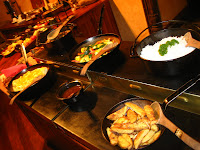
I doubt even two hours had passed before they were calling us for high tea, which included meat pies, strawberries, kiwis, and coconut, chocolate, and biscuit truffles. On the night game drive, we stopped the car to have drinks, trail mix, and chutney-flavored crisps in a field of zebras. The post-drive, pre-dinner sherry was phenomenal, though I don't know how high my sherry standards are. Dinner was enormously packed with springbok stew, cheesy cauliflower, steamed veggies, rice with gravy, multiple salad platters, potato wedges, and a meringues drenched in some gourmet cherry pie filling. No, thank you, I will not be needing an after-dinner aperitif. I might pass out at this table, actually.

Their "light" breakfast had yogurt, fruit, toast, cereals, muesli, and cookies, and our coffee break on the game drive brought rusks into the equation as well. These are like biscotti—too crunchy to eat unless dipped in some beverage. The next big feast was already smelling good when we returned from our drive--we were met with eggs cooked three different ways next to fried mushrooms, roasted tomatoes, sausage, and bacon. Further down the line, I spread a crumpet with cream, doused it in sherry nut syrup, and topped it all off with more fruit salad.

Unfortunately, due to lions roaming wild, we were not allowed to hike or walk so the time between meals was spent digesting by the pool. My body hadn't done much to work up an appetite before they called high tea again. Lalibela's definition of high tea might not be up to British snuff, but you're not likely to hear complaints when chocolate raspberry and chocolate ganache cupcakes or pizza are on offer. I'd learned my lesson the previous day, though, and only nibbled, saving room in my dreams and my stomach for what dinner would bring.

Along with more company from new guests at the communal dining table, this evening's bounty came in the form of lamb with mint sauce, springbok schnitzel with bleu cheese sauce, mealie pap, green beans, and two cold side salads I had seconds and thirds of. One was a curried vegetable slaw and the other a simple mix of beans that must have been spiced by a magician because I could not get enough. And needless to say, I was more than full when dessert came round. I glanced at the brown lump in front of me and briefly considered foregoing sweets altogether that night.

But as they brought more and more of the decorative plates to the table, each swing of the kitchen door wafted more of the spellbinding aroma my way and my spoon had dug into the dish before I even had time to consider the capitulation.

And thank god for that decision, since this Cape Brandy pudding was possibly the best dessert I've had in South Africa thus far. It was a simple cake with pecan chunks throughout, but the brandy syrup drizzled on top had caramelized in the oven and the top layer was ever-so-slightly crunchy, chewy, a little like an under-fired creme brulee. I ate the whole thing and was going to town on my mom's leftovers before I realized I still had another day at Lalibela. Pace yourself, Linni.

Our final day's brunch had mushroom stroganoff and mince this time, and high tea featured lemon cream tarts and sandwiches. Our goodbye dinner had mixed meat curry, vegetable rice, cinnamon butternut slices, spinach salad,
carved chicken, steamed vegetables, and a ham and tomato couscous that looked and sounded simple yet outshined all the other dishes. Dessert was an apple raisin cobbler, served beside an adorable sprinkling of cocoa powder over a bushman stencil and almost as hard to stop eating as the previous night's masterpiece.

But it wasn't time for a detox diet yet—next stop, the Victoria Falls Hotel.

Linni Eats Stellenbosch: Moyo


For the perfect marriage of sophisticated tastes and childhood thrills, look no further than a treetop table at Moyo, an African buffet paradise on the Spier Wine Estate in Stellenbosch. Not only do you eat in a glorified tree house, but costumed African women come round to paint your face in between courses!

While these course breaks are self-imposed, they provide much-needed downtime when you’re tackling a 180+ dish spread, spanning the entire continent of Africa from salads to desserts and everything in between. If dancers, singers, and other forms of entertainment weren’t around for distraction, food coma might settle in before you get to the Amarula cream sauce or rum spiced bananas, and that would just be a crying shame.

But I’m getting ahead of myself here—the adventure begins with bread. Sounds normal enough, but this is far from your average bowl of rolls. The plate’s edge is decorated with lumps of brie, coconut, and onion bread with coriander seeds, sweet potato and pumpkin bread with pumpkin seeds, Egyptian rose petal semit bread with sesame seeds, and fried Tunisian flat bread. In the center, tiny dishes of dukkah, harissa, and the most uniquely delicious hummus I’ve ever tasted await plunking. I took delicate bites and tried desperately not to fill up, but for what it’s worth, the Tunisians won the bread battle.

A moment of silent hesitation then came over our table as we shot questioning looks at each other. We had our drinks and now nothing was standing between us and the buffet, save for our climb down from the tree. Time to dive in.

The next hour or so of my life was a whirlwind of flavors. Many metaphors come to mind--a rollercoaster, or perhaps a carnival; it’s actually a wonder no stomachache came from such a multiethnic party in my tummy. I began with balsamic-marinated crunchy spinach leaves tossed with a spicy caramelized nut mix. The cold salad bar also featured a green bean and sun-dried tomato salad, a chickpea mint medley, and beets blended with caraway seeds, honey, and garlic. The meats were served with a saffron mayo and date chutney, and while the matured oryx fillet was satisfying, it was the condiments I couldn’t get enough of.

Over at the fish station, dorado was plated with mango relish and butter fish steaks were skewered and fried while you watched, along with grilled strips of calamari steak, marinated in molasses and peanuts.

There was more sea fare over in the potjiekos, a station overflowing with cast-iron pots filled with stews, potjies, and breyanies. The fish breyani was stunningly spiced but the eggplant potjie stole this show. It had a smokey, mushroomy thickness far more intoxicating than any meat—my entire table got seconds. I inquired about the recipe, but got a convoluted reply in a thick accent. I suppose I can’t blame the guy for not wanting to share the secrets to a dish so breathtaking.

There were also springbok shortribs and a lamb tagine roasting in stew pots, with an orange herb sauce on the side. This finalized my opinion that, despite their impressive efforts in every other category, Moyo’s specialty was sauces. My favorite part of the meal might have been using the leftover bread to soak up the date chutney and orange herb saffron soup collecting in the center of my plate.

The usual South African stars shone at dessert—a thick Amarula cream coated soft-serve ice cream, milktart, and especially syrupy koeksisters. I was a little surprised to see zucchini bread and brownies on an African dessert buffet, but neither disappointed. I’m not usually a fan of meringues, either, but these were the perfect texture complimented by dried apricots, crushed pistachios, and a chocolate drizzle. And the final surprise, pears spiced with thyme and rosemary and poached in a red wine that no doubt came from the nearby vineyard. They were reminiscent of Thanksgiving, not an altogether inappropriate sentiment given the amount of food we ate that day.

Those who prefer to recline after a big meal will find plenty of comfortable options at ground level, where futons are laid down beneath Moroccan-style tents and blankets are draped on the backs of chairs. For the ambulatory folk who get antsy after dinner, the restaurant stretches back into many enclaves, one a thickly forested garden path and another filled with colorful leather chairs, carved iron lanterns, mirror mosaic angels and brightly painted wine barrels. I don’t think we saw the entire space, but enough to decide this would be the perfect location for a wedding.

Unfortunately, due to shifting menus, we missed out on the potato and banana curry, gingered sweet potato lentils, butternut cheesecake, and sherry hazelnut cake, all of which sound like they could have tipped the delicate balance I found between hunger and uncomfortable fullness. How I arrived at that balance with so much food, I’m not too sure. My advice? Take one bite of everything. It may sound modest, but one bite each of 180 courses? You do the math.

But for extreme cases like the eggplant potjie, I’ll concede a bit—if it’s really good, take two bites.


Linni Eats Cape Town: Maharaja

Call me ignorant, but I didn't know what halaal meant before coming to South Africa. Apparently it's like kosher, but for Muslims. Given the enormous Muslim population in Cape Town, it's a buzz word you can find stamped on anything from potato chips in the grocery store to a classy beach-front restaurant.

When I first walked into Maharaja, a University of Cape Town campus secret, I was a little put off. One dining companion had groceries in tow, and was almost sent home with her turkey lunchmeat. It wasn't because she wasn't buying anything from Maharaja's purveyor, but because he cannot allow meat in the store.

But luckily we weren't dismayed by this jolly Muslim man's religious restrictions. Call us immoral, but we pleaded and wore him down eventually-with his sunny disposition, it didn't take long. Say what you will about Europeans, but folks on the African continent have been nothing but friendly to us, even after hearing the first tones of a Yank accent. In fact, sometimes that brightens their mood even more.

This proved to be the first of literally countless trips to the Maharaj, who follow stricter halaal standards than most of the joints in Cape Town. The word literally means "permissible" in Arabic, and whether or not it connotes vegetarianism is debatable. This debate is a moot point at Maharaja, where the "chicken" curry uses TVP (Textured Vegetable Protein) in ways I never thought possible. An absence of meat was the last thing on my mind.

What I really came here for, though, was the bunny chow. This is a South African staple, made by filling a loaf of bread with a curry of your choosing. It started during Apartheid, when lower-class citizens were not allowed to sit down at restaurants and therefore needed portable dishes, issued through restaurant back doors. The chow came out to us portable as ever, wrapped in foil that gave way to heaping steam when peeled back. The thing was big enough to feed at least two and too hot to touch-I could hardly imagine carrying it an alley, but maybe the serving methods have changed.

Spilling over with butter beans and curry gravy, the bread was still light and downy, the kind you can squeeze into a ball then watch bounce back. I've ordered this many times since, though it's always a tough decision. There's the mushroom breyani, a highly-spiced, risotto-esque blend of creamy yellow rice and a marinated trio of mushrooms. Then there's the usual staples like palak paneer and tikka masala. But what it usually boils down to, at least for me, is bunny chow or rootie.

Ah, rootie. For you Midwesterners out there, this is like the roti prata served at Flat Top Grill when you put a blue stick in your stir fry concoction-only worlds better. Imagine the eggiest, doughiest, and greasiest pancake imaginable, then flatten it out, heat it in a little more butter for good measure, top it with a stew of butternut squash and chickpeas, then top it all off with some cucumber yogurt sauce. Sound heavenly? Well, it isn't my staple lunch here for nothing. Every Wednesday, before my African drumming class, the jolly Muslim man greeted me, never failing to offer a samosa even though I never ordered one. No, his smile and simple experiments with carbs and curry were enough for me. That, and the occasional banana coconut pineapple lassi.

Meat? Who needs meat?

Sunday, May 11, 2008

Linni Eats Cape Town: The Old Biscuit Mill Neighborgoods Market Samples: 10.05.2008

Quiche, 3 ways: Trout and cream cheese*
Mushroom and gruyere
Salami and olive
Portugese dark, light, and medium-bodied beers
Shiraz from Stellenbosch
Smoked olive tapenade
Roasted kalamatas
Green olives in lemongrass oil
Gorgonzola
Smoked tuna
Orange and ginger Turkish delights
Porcini butter*
Shitake bread*
Mushroom pate
White chocolate espresso beans*
Wasabi peanuts
Pecan pie tartlet
Cinnamon vanilla mixed nuts
Butterscotch brittle
Mushroom brie
Citrus stingers with sea salt
Plums poached in red wine
Brie in Moroccan dukkah
Hazelnut honey
Eucalyptus honey
Cape malay dukkah
Pineapple relish
Goji berries
Raw granola
Raw cacao bean
Ethiopian beberie*
Moroccan harissa and chermoula
Aubergine olive pesto
Rocket walnut pesto
Pancake truffle
Various onion marmalades
Spicy chili jam*
Olive marmalade
Figs
Blue cheese fig and walnut samosa*
Butternut feta spinach samosa
Cardamom clove mulled white wine
Chocolate flavors: White: egoli flake, saffron cardamom, lemon verbena
Milk: cape malay spice, orange, lavender
Dark: lime, pink peppercorn

[this is spread out over a long time period that would include breakfast and lunch]
[and the portions are all teeny]
[and we walk more than two miles each way to get there]
[shut up, it’s not called the FAT pack for nothing]


*things I am OBSESSED with

Thursday, March 20, 2008

Linni Eats Stellenbosch: Sosati

“Where can a girl get some ostrich around here?”

Could I be any more of a tourist? The hostel owner indulged in a quick laugh before maintaining his hospitality and pulling out a menu. Apparently a restaurant called Sosati’s down the road would be a good bet, but I perused the document to find not a single trace of ostrich. Bummer.

I wandered the streets, wondering if I’d ever get to try that bizarre South African animal, and decided to hit up Sosati anyways. The hostel gave us coupons for free wine there and here in Stellenbosch, the Napa of South Africa, that’s a guaranteed glass of delicious.


A Michael Clarke Duncan-esque waiter ushered us warmly into the exotic open space, sporting a bright orange dashiki that reeked of Oxy pride. The lighting fixtures were made of ostrich eggs and wildebeest antlers and cast a glow that I couldn’t help but relate to those cliché African sunsets you see in The Lion King. We were seated at a corner table, between a mini stage scattered with African instruments and a wall covered in one big zebra hide. It may sound like they were overdoing it, but it felt perfect.

I should begin by telling you that sosatie is a South African word used to refer to kebabs. We started our meal by avenging Steve Irwin’s death—that’s right, crocodile sosatie. This tasted like sweet and sour pork, and I’m not sure if that was the sauce or the typical taste of crocodile. There was a lot of fat on the wooden stick, but the parts with meat were pretty tasty.


Now, brace yourself for the next course: wildebeest, springbok and kudu sosaties. In case you’re like me and don’t know what a springbok or kudu is, there are ample photos online. They both appear to be members of the antelope family, but judging by taste all of these meats could be members of the cattle family. I don’t know what I was expecting, but they were just like steak.

At first bite, the three were indistinguishable. Slowly I began to notice subtle differences, though. Wildebeest was chewier and bloodier; kudu was lighter in tint and more pork-like; springbok was the most well-rounded in texture and taste, and my favorite of the bunch. This veritable feast of wild animal came with a side of mealie pap, another South African treat I’d been hearing about. This was a disappointingly bland white lump of starch, similar to polenta in texture but lacking in any flavor whatsoever. Our banana salad made up for it, though—sliced banana, papaya and pineapple were mixed in a creamy sweet mustard sauce and tossed with pumpkin seeds. This essentially served as dessert—our stomachs were too full to even consider dessert. This was unfortunate, considering the koeksisters being brought to tables all around us. These are fried shiny pastry braids similar to donuts, but drenched in syrup and surrounded by ice cream. As if that wasn’t amazing enough, their name is always good for a chuckle.

I could go on, but any writing talents of mine are rendered somewhat pointless here. Eating four different kinds of animal I’ve never tried before, many of which don’t even exist in the States, kind of speaks for itself. As the different waiters took turns banging on the drums and talking to us about Barack Obama and Michael Jordan, I had no choice but to lean back in my chair, fully content with my African experience. Because even though I haven’t seen many safari animals yet, at least I can now say I’ve eaten them.

Friday, February 15, 2008

Linni Eats Cape Town: Ocean Basket


I’m a big fan of puns, so when I read that the slogan for the Ocean Basket seafood joint was “Your Sole Provider,” you could say I was hooked.

At Cape Town’s Victoria and Alfred Waterfront, it’s hard to tell where your best meal is hiding. Herds of tourists disembark from short boat cruises to Robben Island while others stampede through the mall on a hunt for “authentic” wooden salad spoons and carved ostrich eggs. Everyone’s hungry for seafood and it’s nearly impossible to tell the fried fish chains from the real thing. The Ocean Basket may not have been the most glamorous of the area’s offerings, but it certainly wasn’t the seediest either.

I should mention that we had my roommate and his friend in tow, both from Namibia, both sushi virgins and possibly even seafood virgins. Certainly chopstick virgins. That part was fun.

Our table of four decided to share a California roll, a salmon roll, and the Princess Platter. The table’s sushi veterans were unimpressed with the Ocean Basket’s take on those standard rolls that had too much rice and hardly tasted like fish, but we were too busy educating the Namibians to care. It was good that we saved room, however, because the main course was enormous.

The Princess Platter comes with 18 prawns, grilled sole, French fries, fried haloumi cheese, and grilled calamari steaks, all on a bed of spanich rice. The prawns, eyes and claws still intact, felt and tasted like buttery delicious lobster and were just as fun and messy to eat. I’m not usually a fan of calamari, but the little orbs they served were seasoned perfectly and gave me new appreciation for what goes into the glorified fried version you see on so many appetizer menus. The sole was also seasoned and grilled to perfection, and had a texture that reminded me of the ocean’s presence just outside the balcony.

The rice, bright yellow and infused with diced vegetables here and there, had sat patiently on the bottom of the fish, soaking up all the juices and waiting for us to discover it’s presence. The wait was worth it because I have never had rice that moist or flavorful, at least not outside of a risotto. And possibly my favorite part, though it would be impossible to choose, was the haloumi cheese. I think pan-fried cheese should just become a part of every region’s cuisine; those crazy Grecians yelling “Opa!” have the right idea.

Our waiter Wellington kindly wrapped up the massive leftovers we had while we paid the bill—less than ten dollars a person. Once the shock and awe wore off, me and my food baby collapsed on the bus and slipped into a rice-induced coma the whole way home.

Linni Eats Cape Town: Fat Cactus

Call me ignorant, but when departing for my great South African adventure, I actually contemplated whether or not cows existed over here. I didn’t know what to expect in the way of milk or steak, and I was prepping myself for five desperate months without a taco. The thought gave me nightmares at first, but I was learning to cope.

So you guys back in California can understand how I felt upon hearing about a Mexican restaurant just a three-minute walk from Liesbeek Gardens, the res hall I call temporary home. And you can further feel my excitement upon hearing that this place has a happy hour from noon to 6, every day.

Six hour happy hour? Does it even matter if the food is good?

To me, yes. To a Mexican-obsessed, carnivorous, can’t-go-a-week-without-asada girl like me, a thousand times yes. So it was off to the Fat Cactus to test their tortilla-wielding skills, with a slightly diminished set of expectations than the ones I bring to California’s burrito joints.

Seated in our booth at this overwhelmingly decorated space, I could have convinced myself this was the States, easily. There was so much spurious Tex-Mex paraphernalia lining the walls that I half expected our waiter to come out and say “Welcome to Chili’s!” I appreciated the effort, but seriously—how the heck is the food?

The menu was definitely not limited to Mexican, that’s for sure—burgers and rib-eye steaks were easy to avoid, though, since they cost a lot more than the Mexican fare. I should mention that this section of the menu was called “South of the Border.” Funny, I’ve always wondered what type of food they eat in Antarctica.

Anyways, we started off with sweet potato puffers, which were basically sweet potato chips served with salsa, guacamole, and bean dip. The chips were baked so I felt better about gorging on them, but there was no excuse when the chips ran out and I went at the bean dip with my spoon.

Their quesadillas are named after musicians, and while the Elvis was tempting with its bacon and banana blend, I went for the Zappa—steak, jack cheese, and avocado. The steak was straight out of a taco truck, cooked in chunks and marinated in a fashion I thought only immigrants and Rick Bayless had mastered. They stayed true to their Chili’s roots by topping it with endless amounts of guacamole and sour cream, but it was easy to push to the side.

The feta and mushroom Clapton quesadilla was also satisfying, though not necessarily what you’d call traditional Mexican. Their nacho platters were big enough to be whole meals, and served that purpose for many at my table. The enchiladas were served deep-dish style in a mini casserole dish and I didn’t get to try them, but they looked appropriately melty and indulgent.

All in all, this meal was pretty pricey by Cape Town standards. Even happy hour marg pitchers set you back at least four dollars. It isn’t the cheap and greasy joint I’d hoped for with dollar tacos, but I can’t complain. At least I know now that there are some cows nearby to satiate those asada urges.

Linni Eats Cape Town: Nyoni's Kraal

I’ve spent the better part of my young adult years wondering where the hell my last name came from. German, Irish, Swiss, French, Welsh—none of my heritage seems to suggest the bizarre word that is “Kral.” I’ve always felt a little alienated by its lack of meaning.

Slowly, though, the name has come up in bizarre places. In Amsterdam, I came across a Kral Photography, and my guidebook to South Africa mentioned that those colorful huts on the beaches are referred to as “kraals.” These Dutch hints finally lead me to Nyoni’s Kraal, a traditional South African restaurant on Long Street in the Cape Town city bowl.

Though the word itself is Dutch, the restaurant’s décor is very…safari. Elegant safari. The kind where you’d sport matching scarves, earrings, and pumps with your khaki fatigues. The staff is laidback and offered to put the African Cup of Nations game on for us, though it seemed very anti-whatever vibe this place was going for. The wealthy Afrikaner diners may have been put off, but we certainly pleased the kitchen crew, who peeked out to check the score every five minutes.

They brought out some steam bread for us with an assortment of garlic, chili, and herb butters. I should mention that steam bread may just be the perfect way to start a meal—the lightest, most airy slices I’ve seen, subtly sweet, encased in a thin crispy crust that is somehow as light as the rest of the loaf while still being crunchy. The menu was divided into many categories, including braai, South African, and Cape Townian. The Kraal purse was a starter of striped crunchy filo surrounding the spinach and feta mix that everyone in this city seems to go crazy for.

The local lasagna was a heavy endeavor, comprised of cream sauce-soaked vegetables in a bowl beneath a flat pasta sheet coated in melted cheese. (Other restaurants in the area have proven that that is how they do lasagna in Cape Town.) I tried a classic South African dish, the breyani, a hump of minced beef and rice with sweet Indian spices, topped with diced tomatoes and a cucumber-yogurt sauce and flanked by little fried bread balls that were hush-puppy-esque, though a little tougher and therefore not as good.

The meal was topped off with the epitomous Cape Town dessert item, malva pudding. This liquor-drenched spongecake was like gingerbread doused in brandy, served with vanilla cream sauce and ice cream. I’d been warned about this staple, as if it would be scary or difficult to sample, but it was definitely an enjoyable experience.

I was sad to see the safari come to an end, but delighted to know that if all else fails, I can identify with Dutch South African colonizers! They may have a history of oppression, but they sure know how to cook.

Linni Eats Cape Town: Cocoa Wah-Wah

Cocoa Wah-Wah. I don’t even know where to begin. If ever heaven existed on earth, it may very well be in this South African paradise of refreshing drinks, Michael Jackson-obsessed waiters, and free wireless internet. But I’m getting ahead of myself here.

This Eden hides on the main strip near the University of Cape Town. If it has any signage, it’s obscured by large trees—I thought it was a dentist’s office for my first few days here. But the whispers of free internet circulated and soon throngs of wireless-starved and Facebook-obsessed Americans made plans to visit the café.

The interior smacks of sunshine, with white, yellow, and orange everywhere. One side features a wall covered in alphabet magnets, which the waiters have arranged to say “Obama=Bliss.” There’s a basket with blankets and games like Monopoly and Jenga and a table stacked with magazines of every genre. Pastries adorn the countertop and bottles of hard liquor are propped upside down behind it, at-the-ready for shots when the slow wireless has got you cranky. The mirror in the bathroom says “You are beautiful,” but the African waiters will tell you the same in between their renditions of “Thriller” and old Craig David songs. And I haven’t even gotten to the food.

My first time around was a bowl of Bulgarian yogurt with meusli, papaya, pineapple, apple, and dried banana. In a place that seems casual, I was surprised to find they’d artfully drizzled a honey swirl across the bowl’s rim and dashed some cinnamon on there, too. Their drink specialty is the Crush, and the Mango Mint Crush gave me brainfreeze after blissful brainfreeze. The Chai Chiller aint half bad, either.

Moving on to sandwiches. While my dining companion wasn’t wowed by the sloppy mess of a cheeseburger, Cocoa specializes more in healthy fare. She sampled the Sun-dried Tomato and Feta Tramezzini during another visit and while the bread was a little too much for the minimal amount of ingredients, the taste was on par with other Cocoa fare. Their chicken and avocado wrap features orange-tinted chicken that tasted like tarragon, and all these sandwiches come served with a side of roasted veggies and the best fried potato wedges I have ever tasted—no joke, they actually look like potatoes and go perfectly with the South African ketchup that actually tastes like tomatoes!

Other winners on the menu include the Pesto Almond Pasta, grilled cheese and tomato, and grilled mozzarella, olive, and tomato sandwich. These pressed flat “toasters” are served on dark sandwich bread and are kind of a steal if you’re coming here broke. Another money-saver is the Breakfast Expresso, a standard breakfast of bacon, eggs, and toast with tomato slices and jam.

Have I still not convinced you to buy that one-way ticket to Cape Town? They offer a make-your-own-muffin service, where you drop by anytime before 11p.m., when they close for the evening, and put in an order for a muffin that you can then pick up the next morning. You can choose from a cocoa or pumpkin base and add things like espresso and white chocolate. Muffins that come standard daily include the spinach and feta, carrot cake, and banana meusli. And the star of their bakery case comes in the form of a chocolate-chocolate cookie with a fudge center that they insist on heating up for you before you eat it. It’s the size of a discus and weighs about the same.

Now that I’ve typed the longest internet café review in the world, I’m going to leave you on this note—all the things I’ve mentioned cost around 50 rand or less, which means you can walk away from Cocoa no more than six American bucks lighter than when you came in. Enjoy your flight.

Welcome to Cape Town!


Whoever told me that South Africans eat nothing but meat and starch (cough, LonelyPlanet, cough) must have never visited the country. I’ve eaten a lot in just a few weeks, and while meat and starch play important and delicious roles, they’re far from the only thing offered.

That said, all bread I’ve tried is extremely hearty. Even the bread offered as a precursor to dinner at restaurants is brown and full of seeds. The one exception is steam bread, a traditional recipe with some beautiful name that I’ve forgotten, though I’m pretty sure it has clicks in it. The slices are very light, the interior moist and airy, while the thin crust provides a quite satisfying crunch. And to top it all off, there’s this fruity sweetness to it that I can’t place, but it’s unlike any bread I’ve ever tasted before.

We’ve had multiple braais, which is what the South Africans call their barbecues. They’re eerily reminiscent of American barbecues, serving meat with Italian salad, beer, and perhaps even beans. One afternoon, we got roasted lamb that fell apart after hours on the grill, all stacked in the corner of the braai, ready for scooping. I had way too much of this, and thanked the man behind the grill a zillion times. They’re very proud and competitive about their braais, so I figured it was the least I could do to show my appreciation.

Another braai served boerewors, a spicy sausage that was red inside, for some reason unknown to me (but I try not to question when things taste good.) The campus food is also stellar—we found a tiny Indian stand made of brightly painted wood, sort of giving off a circus vibe. The tiny woman behind it served up apple cinnamon, butternut squash, and spinach & feta samosas. Did I mention they were 60 cents each and the size of my fist? Did I also mention this stand is in the philosophy and politics building where all my classes are? Yeah.

They like to call their paninis “tramezzinis” here, tahini is referred to as sesame pulp, and sunflower seed oil is just sunflower fat. It’s very difficult to find skim milk or yogurt, I’ve only seen one McDonalds, and there are KFC’s everywhere.

Drinkwise, I’ve sampled the local Castle and Black Label beers (Black Label is the way to go, as if you can’t tell by the name). Amarula is their cream liquor from an African plant, but it’s pretty indistinguishable from Baileys. Instead of Smirnoff Ice with a variety of flavors, here they just offer Smirnoff Twist, a lemony bottle of 5.5% alcohol that could pass for Sprite if it really wanted to. I tried the locally-brewed sorghum beer, made from sorghum and served in a huge wooden bowl. To be quite honest, it tasted like beer-flavored yogurt that had been left out on the counter for a few days. But the experience of drinking it and passing the huge bowl around was a fun one.

And finally, I ordered my first frilly mixed drink in a restaurant my second night here—it had a fancy name that other Americans at my table knew, but I can’t recall. The umbrella spear sported some pineapple and lime slices and sat atop a mix of ginger beer, dark rum, and lime juice. At the risk of pulling a she-who-must-not-be-named, yummo.

I should also mention that, at a bar called Rafiki that played Sublime and the Beatles, I asked for a lime to accompany my tequila shot and was given another shot of lime flavored liquor. Noted.

GLOSSARY:
Boerewors—spicy sausage
Breyani—mix of rice and minced meat, sweetly spiced with yogurt sauce
Malva pudding—brandy-soaked sponge cake topped with vanilla cream
Geelrys—rice with raisins and spices
Blatjang—spicy fruit chutney
Smoorsnoek—flaked snoek with potato slices and tomato
Witblitz—strong spirit distilled from peaches
Sosaties—kebabs of meet, onion, and dried fruit basted in a curry sauce and grilled
Bobotie—minced beef baked with egg custard topping
Melktert—milk tart with cinnamon topping
Mealie papp—porridge/grits
Bunny chow—portable loaf of bread filled with curry, made during apartheid when blacks weren’t allowed in restaurants


STILL TO TRY:
mealie papp, bunny chow, ostrich, cape malay cooking, bobotie, melktert, sosaties

Wednesday, October 3, 2007

Linni Eats L.A.: El Huarache Azteca #1

This world has myriad lessons to offer me. I’ve picked up quite a few gems of knowledge in school, in topics ranging from the mass media’s meddling in politics to oppressive post-colonial relationships. Outside of the Oxy bubble, however, I recently had a profoundly eye-opening experience just a half-mile east on York Blvd.

It is here, beyond Marty’s and The York, buried deep in a Spanish-speaking territory with a tendency to intimidate that you’ll find El Huarache Azteca #1. From the street, it looks just like any other Mexican hole-in-the-wall. They’re all over L.A., boasting carne asada tacos, burritos and whatever other doughy concoctions can be dreamed up to hold meat. They all look the same—dirty, nondescript and not worth the time or effort. Why take a chance on a seemingly broke-down storefront whose signs you can’t read and who barely has the wherewithal to name their restaurant? I’ll just stick to Leo’s for my taco fix, thank you.


At least this used to be my outlook, before I took said chance on huaraches. The word means sandal in Spanish, and I had to know what they were serving that not only warrants that name, but deserves to be the shop’s namesake. As it turns out, a huarache isn’t far from a sope—the thick, fried masa dough is shaped into an oval vaguely reminiscent of an Old Navy flip-flop and topped with the meat of your choosing, sprinkled with cotija cheese and cilantro and drizzled with milky crema. But here’s the kicker [pun intended]—the “shoe” is filled with a thin layer of refried beans. I made the mistake of gobbling this up too fast the first time, but that’s another lesson learned—take it slow. You have to appreciate the simple greatness of this dish, let it consume you, become one with the huarache.


El Huarache Azteca #1 holds a special place in my heart, not simply because it freed me from the false stereotype of dingy Mexican joints. I will always remember this place as the first time I tried lengua and huitlacoche as taco fillings—tongue and corn fungus, respectively. This restaurant offers you just about anything you want in any form you want it, from brain on a quesadilla to tripe in a burrito; you can even get their famed barbacoa on Saturdays and Sundays piled onto a sope or torta. The tongue was pink and softer than any meat I’ve ever tasted, while the huitlacoche had an almost bitter taste like the juice in a jar of kalamata olives.


The best part about taking risks here is that you won’t break the bank if you realize you don’t like to eat stomach lining after already paying for it. Three tacos and a pop cost $2.99, as does the huarachito (smaller huarache) served with rice, beans and a drink. In addition to the usual sodas and Jarritos, they have five large containers lining their countertop, filled with agues frescas made daily in a variety of flavors. Horchata will always be my favorite, but the pina is great for those who like something sweet and fruity, and the tamarindo offers a less-sugary, brown-hued substitute for you Coke-lovers out there. They’re so fresh, I didn’t even mind squeezing the chunks of pineapple through my straw.

The daily specials are also not to be missed—from the spicy albondigas on Mondays to Wednesdays’ mole verde and caldo de pollo, the soup-slingers and masa masters behind the counter here sure know what they’re doing.

So don’t be fooled by the plastic silverware and Styrofoam plates. Don’t let Highland Park’s dingy dollar stores and nameless storefronts keep you away from a culinary experience that blows corporate “clean” Mexican places out of the water. I’ve learned my lesson, and it’s time you learned yours—if a Mexican place doesn’t seem dirty and seedy, it probably isn’t good.

El Huarache Azteca #1
5225 York Blvd.

Wednesday, September 19, 2007

Linni Eats L.A.: Chungkiwa


Surprisingly close to Oxy, past the chaotic strip of Alvarado known as Filipinotown and through a dizzying maze of strip malls, there is a magical place called Koreatown, home to the dining craze, Korean barbecue.

To describe my first BBQ experience in K-Town as overwhelming would be like describing Lindsay Lohan as an occasional drug user. Respectively, I have never been so confused and Lindsay has never had more reason to be in rehab. Upon entering Chungkiwa, I was too befuddled to even speak to the hostess about my dinner reservations. I instead stared at the enormous tables, set ablaze by tiny Korean women, empowered by their fire-starting ability and shared knowledge that they could serve unsuspecting white folks cow tongue without them knowing.

I was seated near a table of Korean business men and my party was late, so I had the opportunity to observe the process prior to placing my own order. I watched, simultaneously intrigued by the giant pit in the center of my table and the giant plates of raw meat being brought to the men beside me. Studying the menu proved fruitless, as most of it was in Korean, and I saw no buffet to uncomplicated the procedure—I was in pretty dire straits.

Mustering what courage I could in this culinary equivalent of a wild-life safari, I peeped at the waitress and pleaded for guidance. In what little English she had in her, she got the point across that we should order five plates of meat for our party of seven. We’d be needing two plates of the kalbi, their specialty beef short ribs, some chicken and pork for the less adventurous and a plate of kalbi with mushrooms. I have been having a love affair with mushrooms this summer and always make a point to order them, no matter the format in which they are being served.


I sensed we were being duped into spending too much, but figured that was almost unavoidable in a situation like this. Our waitress made a production of the routine fire-starting I’m sure she does hundreds of times in a day. In a flash of lighter fluid and matches, the pit in the middle of the table was set ablaze and soon enough slabs that closely resembled extremely thick-cut bacon were being tossed on, grilled and diced up with industrial-strength scissors.

I should mention that prior to the meat, our table was blanketed with countless mis-en-place dishes filled with various unidentifiable appetizers and accompaniments for our meal. The star of these snacks, known as panchan, was the sweet black beans—shiny and jet black, the sugary things appeared far healthier than they tasted. Winner of the most intriguing award definitely went to the bluish white sponge that tasted like nothing and turned out to be egg. What kind of egg and cooked in what way, I have no idea, but the waitress didn’t understand when I posed these inquiries. Oh, and did I mention all of these dishes are refillable?


Soon enough, the kalbi was roasting and filling our tiny back room with an aroma so intoxicating that I thought I’d accidentally downed one of the 40 oz. Korean beers available to those old enough to buy one—I, unfortunately, am not. Chungkiwa prides itself on serving all USDA-certified Angus beef from extremely juicy, lean and flavorful cows, and it shows—or should I say it tastes? Either way, we had no trouble finishing what I had originally considered an exorbitant amount of food. The steak is coaxed by the burners into wilting capitulation, melting in your mouth between the rice noodle sheets, given to wrap around the beef in a distant approximation of a sandwich. Fresh, thin daikon slices are also offered for this purpose.

The mushrooms were, of course, too delicious for their own good once steeped in the smokey aroma of Angus beef. Large silver pots of cold barley tea were constantly being refilled as we washed down swallow after swallow of the spicy kimchee and kalbi. Rather than having food leftover, my table was left picking at the scraps in the burner bowl as our waitress tried to carry it away.

My advice to those considering this adventure is to bring a Korean if you can find one—a wise Oxy student offered me this counsel and I ignored it. It isn’t that you can’t survive without knowing the language, because I’d like to think I did quite well for a first-timer with just a few years of high school French under my belt. However, it would have been nice to know what exactly I was dipping my fork into in those mysterious white dishes, how to ask about dessert or how to inquire about prices. At about twenty bucks for a plate of meat with all the accoutrements, the bill could be kept under control if you exercise caution, but I’ve heard that other K-Town offerings have all-you-can eat buffets for as little as $14.99. Chungkiwa’s Angus beef was undoubtedly spectacular, but you might want to try something like Tahoe Galbi if you’re pinching pennies. And, let’s face it, aren’t we all? Chungkiwa is located at 3545 W. Olympic Boulevard; Tahoe Galbi can be found at 3986 Wilshire Boulevard.

Sunday, May 20, 2007

Linni Eats Chicago: Johnnie's Beef


Well, it's summer and I have officially returned to the gusty winds and moody weather of Chicago. What better way to celebrate my arrival than a trip to the legendary Johnnie's Italian Beef in Elmwood Park? On the long stretch of North Avenue leading to the airport, Johnnie's tempts me to stay each time I depart for Los Angeles and I have daydreams of the juiciness as I suffer through southern California's dry heat.

Daydreams no more, my month-long cravings were satisfied on a recent trip to the miniscule store front that hides massive flavor. One step in the door and the smell alone reminded me of what I had been missing. No dreams of Johnnie's beef could do it justice, not even aromatic memories. The usual line extended out the door, but was actually pretty small for this time of year. Throngs will soon come from all corners of Chicago to wrap around the building like a necklace of summer salivations, frought with the anticipation of such a primal satisfaction.


You can spot the folks who have been here before by the way they order. "I'll take one beef, almost dry," requests one plump man, whose well-fed belly stretches out the front of his White Sox World Series Champs t-shirt. Another customer steps up behind him, this time a younger boy--"Two spicy beefs, two fries." This kid knows his stuff so well, he doesn't bother with any extraneous words. Others follow, hopefully knowing what they are doing or with someone who does. An aged woman, clearly a seasoned Johnnie's veteran, orders an extra-juicy beef and I look down at the tiny counter where my sandwich is propped, wishing I had ordered it a little more sauced. The no-nonsense workers behind the counter seem like the intimidating type, but they will actually accomodate just about any requests regarding juice and spice.

If you're feeling especially carnivorous (as I so often am) order a combo--this has an Italian sausage embedded in the beef sandwich, soaking up whatever amount of juice you've stipulated, providing a spicy kick to the surrounding meat and appropriately soaked bun. Their menu also offers tamales and hot dogs, but those in the know come here for one reason and one reason only--to get a taste of the best Italian beef in Chicago, the Midwest, and possibly even the United States.

Tuesday, April 17, 2007

Congratulations, Jonathan Gold!

Yesterday, April 16, Jonathan Gold became the first food writer to win the Pulitzer Prize for Criticism. He has written for Gourmet magazine and is currently the food critic at the LA Weekly.

Big congrats to Jonathan, for bringing this incomparable level of respect to the world of food writing!

Thursday, March 29, 2007

Linni Eats L.A.: Mi Piace


Los Angeles has the most competitive restaurant scene I've ever witnessed. There are perfectly good restaurants that I wouldn't go back to eagerly, simply because there are so many new places to try. Why waste time eating somewhere you have already tried when you could test out that hot new Thai Latin fusion everyone's been talking about? Or that classic Italian trattoria that you can't believe you haven't tried yet? For me, wanting to visit a restaurant twice is an enormous compliment--you have got to have one hell of a menu for me to think there is something worth coming back for. This is not food elitism--it is the simple reality of living in this melting pot of people, cultures, and kitchens.


That said, I have found a restaurant I will willingly take guests to, will happily open the doors of time and time again, and that place is Mi Piace, an Italian showcase of glamour and glitz on the Colorado strip. Outdoor seating stretches the distance of three store-fronts and couples with dogs casually co-exist with elegant groups and hostesses who are too pretty for their own good. Your typical L.A. woman can be found in front of the dessert case, picking at her salad and trying not to glance up at the shining glass box of pastries that are actually prettier than the hostesses.

Seating varies from large wooden tables to low-riding white leather booths that require some mild gymnastics to get comfortable in. Once that is settled, a lively waiter will likely grace you with his presence, dripping with the charisma of an aspiring actor. He will bring you their trademark herb bread, delicious alone but out of this world with their vinegar-olive oil plate, poured simultaneously at the table to create a beautiful split.

The Fiammiferi di Zucchini, or crispy zucchini sticks, arrived next with a spicy roasted sweet bell pepper sauce. These were only ok, but no one noticed because our other appetizer was the Calamari Fritti, which came with a housemade lime, cilantro, and jalapeno dipping sauce that knocked us back in our loungey leather seats. These threatened to fill us up, as did the next course, salads. Insalata di Spinaci was a baby spinach dish tossed with dried Michigan cherries, sliced strawberries, caramalized pecans, California goat cheese, and a star anise apple cider balsamic dressing. The description alone is a mouthful, and the taste was equally overwhelming in the best possible way.

The absolute star of the meal arrived for me next--Ravioli Al Burro E Salvia, ricotta and pumpkin ravioli in brown butter and creamy pesto sauce. The creaminess of this dish forced me to close my eyes momentarily, and the lids continued to flutter as I detected strong hints of sage from the leaves perched atop the fresh pasta. The ravioli, made entirely from scratch, was featherlight and thin, just strong enough to hold it's heavenly sweet pumpkin interior, which tasted exactly like Thanksgiving.


One of the day's specials, the Osso Bucco di Vitello, featured a slow-braised veal shank with port wine, julienne of carrots, onions, celery, tomatoes, and fresh thyme, all atop a mushroom risotto. This came close to the angelic status of my previous dish, and next in line was the Petti di Pollo, a roasted free-range chicken breast stuffed with mozzarella, pesto, and basil and served with a couscous-fresh vegetable medley in a creamy roasted garlic sauce. Their side pasta dishes all shine the brightest--it is clear that the couscous and risotto were made from nothing but flour, eggs, and dedication to good food.

I really enjoyed the feeling that Mi Piace knew me, understood how I operated and could push just far enough without filling me up. Your typical Italian joint loads you up with enough pasta to feed a family of marathon runners, and many would argue that is tradition and that is how it should be. Mi Piace, however, also prides themselves on their bakery--all bread and desserts are made by their own Pasadena Baking Company. Luckily, the portion sizes were perfect to leave us ready and willing to tackle that dessert case in front. Throwing caution to the wind, we ordered a dreamy mango mousse, the New York style cheesecake, the mysterious banana pyramid, and a miniature apple pie. Some of these may sound basic, but believe me, they were not.


The apple pie held a secret savory dash of rosemary, which elevated the American flavor to gourmet status. The cheesecake came in a neat circular unit, seated atop a brownie crust, rolled in chocolate sprinkles, and capped by decadent chocolate frosting and caramelized pecans. The mango dish was more like a petit four, with an airy cake surrounded by a thick mango sauce. The mystery of the banana pyramid was solved, much to my delight, when we discovered a banana cream filling on a thick chocolate crust, rolled in almond chips. This was all presented so beautiful, we almost didn't want to eat them.


On top of all the spectacular things we did try, there were at least five other menu items I need to come back for. To give you an idea of how extensive the menu is, let me just tell you that half of our party was stuck in traffic for 30 minutes and we still hadn't decided by the time they arrived. As if that weren't enough, Mi Piace's kitchen dishes us breakfast as well. The Waffles Bambinos are four baby waffles with sauteed bananas, walnuts, and brown sugar. They also offer savory breakfast items like the Smoked Salmon Fritatta and Spinach and Mushroom Croissant. As swanky as the space can be at night, it would be just as good for people-watching on a Sunday morning by yourself or with the whole family. There is really no group you can't take here, it has something to satisfy every taste. I can't recommend it enough and I am waiting with bated breath to see what my next visit will bring.

Mi Piace
25 E. Colorado Blvd.
Pasadena, CA
(626) 795-3131

Linni Eats L.A.: The Counter


When it comes to making your dining experience one of a kind, the folks at the Counter get right to the point by handing a clipboard to anyone who enters the crisp, modern Santa Monica space. Chic silver chairs and cool blue walls give a clean background for the eclectic art and wine collection adorning the walls. The diversity of design carries over into the patrons who stockpile at tables and of course, the Counter. Sit here to avoid the waiting list for a table and gain the added bonus of a menu tour guide—the staff behind the bar will answer any questions you have about the menu, as well as offer suggestions about their favorite combinations.

Each clipboard comes standard with a menu printed at the bottom, including regular specials like the 50/50 fries, where your table gets to choose two fried items from the list of sweet potato fries, fried onions, and regular old French fries. They also serve uncommon fare along the lines of cranberry-topped turkey chili and hobo packets, a childhood camping favorite of mine that involves taking whatever veggies you’ve got, wrapping them in foil and tossing it in the fire. The result is delicious and I’ve never before seen a restaurant try it.

Above this menu, you’ll find a tear-off checklist of burger accessories, organized into neat sections to simplify the near-impossible task of designing your sandwich. First, choose your meat—their beef is freshly-ground 100% natural Angus from corn-fed cattle raised on an all-vegetarian diet, but if you’re not feeling that, go for the turkey or veggie burger, or even grilled chicken. Next up, decide how hungry you are—burgers come in 1/3, 2/3 and 1lb. sizes. I chose the 1/3 lb and it was definitely enough, but there’s no shame in going big! Cheese comes next, and I chose the Danish Blue Cheese from an agonizing list of ten amazing choices. To complement that, I chose dried cranberries, grilled pineapple, mixed baby greens and avocado from the list of toppings and with the help of a friendly staffer, chose the apricot sauce to dip it all in. The fifth and final step is choosing your bread—hamburger buns, honey wheat buns and English muffins are all available, as well as the option to have your burger in a bowl on a bed of lettuce.

When this masterpiece arrived, I didn’t even want to disrupt the beautiful display with my silly mouth. I couldn’t bite into this any more than I could bite into a Monet painting! But of course, the hunger that developed in traffic en route to Santa Monica overcame me. The leaning tower of beef was toppled, the heavens opened up, naked chubby babies with harps sang to me…ok, not quite. But this was one of the best burgers I have ever tasted. Call me crazy, but for a moment I wished the toppings weren’t in the way so I could just taste the pure, unadultered cow.

Mine was cooked medium-well, but the menu suggests getting it done medium and after sampling my friend’s medium patty, my lesson was definitely learned. This didn’t stop it from being appropriately crumbly, juicy and moist, the perfect base for the salad of toppings I had selected. The waitress said I could try another sauce if I thought the apricot was too sweet, but it was just right for this fruity sandwich. The English muffin I ordered wasn’t dry or rigid like I feared. It absorbed the mixture of blue cheese morsels and sauce and hugged the interior like a crunchy blanket. I also got to try a medley of lettuce, avocado, american cheese, and dill pickles with honey mustard and the melted cheese took the burger to a whole new gooey dimension, wholly distinct from the blue cheese experience.


If you’re feeling overwhelmed by the 27 toppings listed, they do have a few tried-and-true recipes on the menu, as well as a burger of the month. They featured a halibut burger with jicama slaw while I was there, and I can’t wait to go back and try their namesake Counter Burger, served with sharp provolone, lettuce, tomato, fried onion strings, sautéed mushrooms and sun-dried tomato vinaigrette. There’s also the herb goat cheese spread and gruyere left to sample, the caramelized onion marmalade and roasted garlic aioli have yet to tantalize my taste buds, and I won’t even get into the laundry list of toppings I have yet to explore—lets just say there are sun-dried tomatoes and honey-cured bacon strips in my future.

Believe it or not, this whole sandwich was under ten bucks, and the entire bill was less than 15 when you add my apple pie milkshake, with actual pieces of crust and apple blended in. They also whip up banana, peanut butter, and coffee flavored shakes and malts. The only downside to the Counter is its location, easily a half hour drive from Oxy, but if you get some friends together for a beach trip and make a day of it, I promise you they won’t let you down. For a full menu and locations, visit www.thecounterburger.com.

Saturday, March 10, 2007

Linni Eats Chicago: Hot Doug's


When I emailed Hot Doug to inquire about the day's specials, he replied pleasantly, signing the message "Sausagely, Doug." This is just a preface to the wonderful things he will continue to do throughout the story of my first experience at Hot Doug's Sausage Superstore and Encased Meat Emporium. I can only hope this will be the first of many entries to come, as he rotates his specials on a daily basis.


We arrived at 3:45 on a Saturday, one of the only days out of each week that Doug dishes up his Duck Fat French Fries(the other day is Friday). The store closes at 4pm and a line of at least 20 people wrapped its way outside and down the block. I parked right out front and could smell the goods before even opening the car door. After a chilly 20 minutes outside, debating whether or not we would make it inside, the warmth finally blanketed us, as did all of the Elvis memoribilia and pictures of people with sausages. This all rested on a pervasive paintjob of primary colors with a giant quote in glittery writing across the wall: "There are no two finer words in the English language than 'encased meats,' my friend."

The specials menu captivated me with tales of Ale & Chipotle Buffalo sausage with Hard Cider mustard and Monterey-Jack cheese and Mediterranean Lamb Sausage with Red-Curry Garlic sauce and Feta cheese. A man on his way out cheerily shouted "Try the rabbit," but unfortunately the White Wine and Dijon Rabbit sausage with Truffle sauce Moutarde and Port Salut cheese that he was referring to was finished for the day. We made our final choices only to be struck by a small cash-only sign. I experienced waves of disappointment to think I couldn't afford the duck fat fries and a special sausage. Apparently, I conveyed these emotions well because next thing I knew, Doug was writing down duck fat fries on our order sheet, saying he couldn't have anyone looking that sad in his store. He cheerily took what money we could give him and told us to get some drinks and find a seat, never once expressing irritation with us.


The order was out in a few short minutes, and the waittress was happy to dump an obscenely large order of the fries on our table. They didn't look like anything impressive but as soon as I popped one of the skinny delights, totally condiment-free, I was overcome by a flavor never this apparent in regular fries. They weren't the super-crispy texture I usually look for, but it didn't matter. They were dashed with grains of sea salt visible to the naked eye, a perfect complement to the smokey, natural flavor.


It was tough to halt my frenzied shoveling action with the fries, but my Apple and Cherry Pork sausage awaited, with Sweet Dijon mustard and Blue cheese, all drizzled with honey and topped with Griottes (tiny canned sour cherries). I ate in brief silence for a minute and closed my eyes to shut out the madness of the restaurant's interior. It was kind of mind-blowing.

Unfortunately, it probably has the potential to blow arteries as well as minds. I opened my eyes to observe the range of healthy-looking customers as well as the more full-bodied ones, and I could tell they were all dedicated Doug-followers, for better or worse. With delirious smiles plastered on everyones' faces, who can even bother to think about the nutritional value of the various encased products? My stomach can't wait to try them all, no matter how my heart feels.


Check www.HotDougs.com to see the day's specials before you go.
Open Monday-Saturday, 10:30-4:00
[If you're outside in the line by 4pm, he will serve you]
3324 N. California
Chicago, IL

Sunday, March 4, 2007

Linni Eats L.A.: Señor Fish

When I say that I have found the cheapest and best seafood in all of Los Angeles, I doubt a small Mexican restaurant in Eagle Rock comes to mind. Believe it or not, this is the case at Senor Fish, where rainbow Christmas lights hang year-round on the wooden porch out front. Massive tree trunks poke up through the floor-boards and one might find themselves leaning their back against one while sitting at one of the lower picnic tables or bar stools that complete the eclectic atmosphere.


A dry-erase board inside lists the day's fresh fish specials. There are usually about eight, but they get erased as the kitchen runs out, a sign of their interest in freshness and quality. Sea bass, salmon, and swordfish tempt you away from the carnitas and asada usually ordered in a taco joint, and listings of fresh tuna and trout distract from your average pastor. Arguably the most popular dish is the Callo de Hacha, an enormous and well-constructed scallop burrito filled with spanish rice, beans, and surprisingly high-quality fish for only 6.50. Not only is this the only place I've ever seen a scallop burrito, it's also probably the only place serving multiple scallops for under seven dollars.


These flakey morsels also work their magic in the soft-shell scallop tacos, amazingly 2.75 each, topped with cilantro and cheese and served with pinto beans and rice. Despite their emphasis on fish, the asada taco was just as good, and I'm willing to bet they don't slack off on the pork or chicken dishes, either. They offer to grill any fish for you, if you prefer that texture, and any of the day's specialty seafood can be ordered in taco, burrito, tostada, torta, enchilada, and quesadilla form. The scallops in the burrito were soft and juicy, while those in the tacos were grilled to achieve an irresistible crunchy exterior.


One might think that it is easy to get away with using mediocre seafood if it is just going to be mashed up in a burrito, but I tested this theory and was shot down. The baby green salad gave the orange roughy room to shine, and shine it did. On a bed of mixed greens, avocado, and mandarin oranges and topped with cotija cheese, this fish was better in quality than a lot of what I've been served in upscale seafood restaurants. And this cost less than ten dollars.

I recommend starting with chips and guacamole, just like any other Mexican joint. Their chips are fried to the point of amazing and there is a full bar of salsa options, of which we tried at least 5. And if you think the dinner prices are cheap, head back for the lunch special, which includes a drink, rice and beans, and two tacos of your choosing for 6.50, 7.50 if you choose shrimp or scallops. And as if they hadn't spoiled us enough, they also offer a weekend breakfast menu. Next time you're craving incredibly good seafood, don't get bogged down by visions of high-class snobs rude waiters, and depleting bank accounts. Senor Fish is making incredibly good seafood at all hours of the day, and you won't have to break the bank for any of it.